
Finding East Orange Residents
East Orange does not maintain one public list of everyone in town. The best starting point depends on whether the search begins with a present address, a person’s name, or a past household. The assessor and parcel sources are useful for a property connection. Essex County’s recorded-instrument index can identify parties to deeds and mortgages. The Main Library’s historical materials can help place a name at an address in a printed year. Each source answers a narrower question than a broad directory claim.
Keep the record date beside every result. An owner’s mailing address can differ from the property address. A court party is not automatically a resident, and a voter-status result is not a household roster. For an old address, write down the street name exactly as printed before normalizing it. East Orange shares directory and border context with several nearby municipalities, so the municipality field matters as much as the street name.
- Start with the full street address in the East Orange property-tax route or the New Jersey parcel explorer.
- Record the municipality, block and lot when the result supplies them, then distinguish the situs address from any mailing address.
- Search the Essex PRESS index by block and lot, instrument number, document type, or grantor and grantee name.
- For a past household, compare a dated directory entry with the Local History Room and State Archives holdings.
- Use a narrow OPRA request or an in-person custodian visit when the official online route does not hold the needed record.
Note: An index hit is a lead, not proof of current occupancy, until its record type, date, and relationship to the address are checked.
East Orange Record Offices
City Hall, the Essex Hall of Records, election offices, courts, and the library divide up East Orange resident evidence. The City Clerk is the municipal records custodian, while the separate Essex County Register of Deeds and Mortgages keeps recorded real-property instruments. The assessor handles property value and tax-map work. The state’s individual voter-status tool is a different channel again. Using the right office saves time and keeps an address search from becoming an unsupported claim about a person.
Essex Register of Deeds
Hall of Records, Room 130
465 MLK Jr. Boulevard, Newark, NJ 07102
973-621-4960
Essex Election Offices
Justice Building, Room 103
495 MLK Boulevard, Newark, NJ 07102
973-621-5061
The city clerk is reached at 973-266-5110 and accepts municipal OPRA requests at opra.request@eastorange-nj.gov. A request should identify a department, an address or subject, and a useful date range rather than ask for all records concerning a person.
East Orange Access Channels
Online search is only one part of an East Orange record trail. PRESS, the city-linked property route, NJGIN, the individual voter-status service, New Jersey Courts, and state vital-record channels are documented online starts. They are useful when the portal covers the period and record type needed. Some systems require a precise address, party name, document reference, or date range. A search result should keep the portal mode, filters, and search date with it.
Several important alternatives remain available when a web search ends. The East Orange Public Library holds the Local History Room. The Essex Register’s Public Vault is the in-person route for older recorded material. City Hall receives focused municipal requests, and the New Jersey State Archives preserves older Essex county series. The research also documents phone, mail, and email channels for the City Clerk, assessor, Register, election offices, and county OPRA custodian. Verify current hours and procedures before a visit or mailing because arrangements can change.
For an identifiable municipal or county record, OPRA works best when a request names the department, record type, address or subject, and a narrow date span. It does not turn protected information into a directory or replace a title search. An unavailable online image may still be available from the office that holds the original or a certified copy.
East Orange Parcel Trails
The East Orange Property Taxation office is the local entry point for assessment, tax-map, property-card, owner, value, and block-and-lot work. Its linked tax search is useful when a complete situs address is known. The research did not capture the live form’s exact labels or its partial-name rules, so a searcher should preserve the wording shown at the time of the search rather than assume a field behaves like another county’s system.
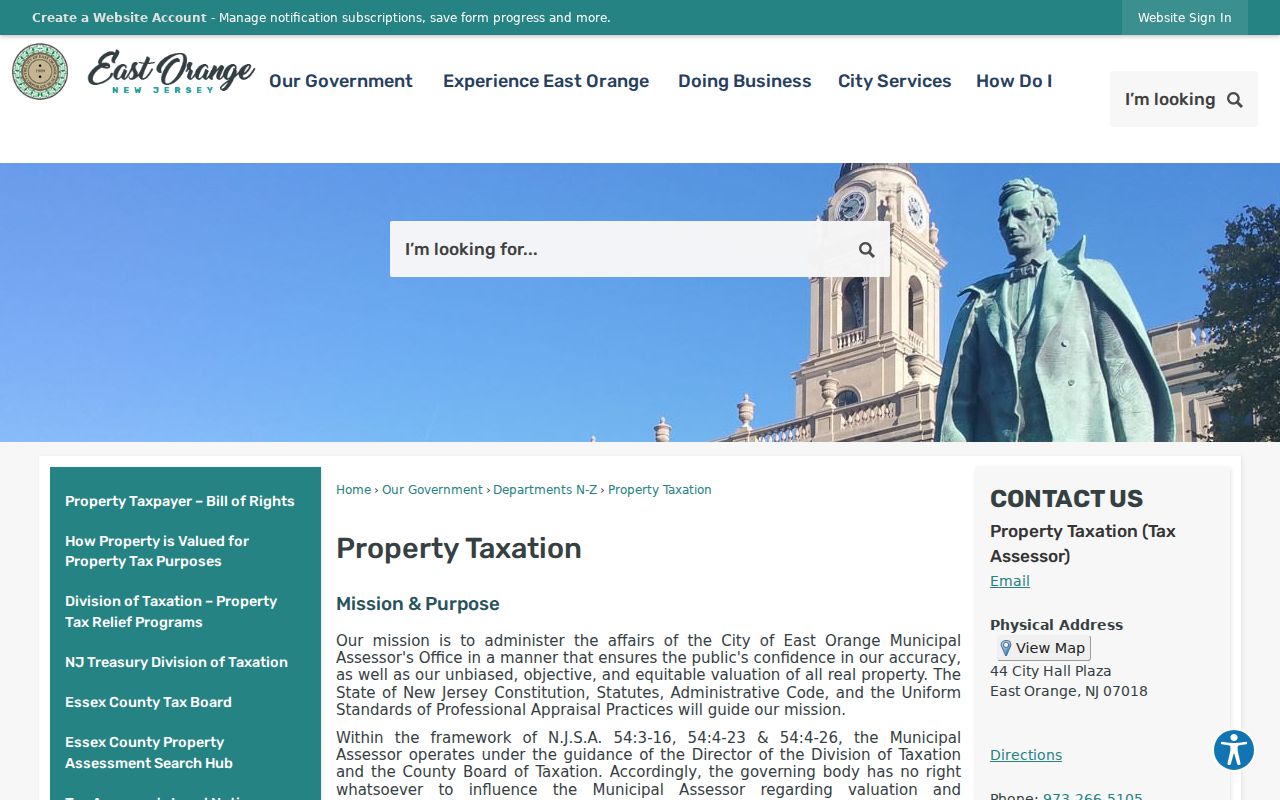
The city source confirms the local assessor route and helps distinguish assessed-property information from evidence of an occupant. The statewide NJGIN Property Explorer is the documented mapping fallback. It searches by address, county, municipality, block, and lot, and it reports a separate August 2026 Essex parcel-geometry update without a MOD-IV attribute change.
| East Orange input | Record use | Careful reading |
|---|---|---|
| Property address | Find a situs record | Keep its spelling and suffix. |
| Owner name | Find a property party | Do not treat it as an occupant list. |
| Block and lot | Join parcel and deed research | Record any qualifier shown. |
| Municipality | Separate East Orange from nearby places | Check the legal municipality. |
| Assessment year | Date the tax information | Annual data can lag a transfer. |
East Orange PRESS Searches
PRESS is the Register’s official search system for deeds, mortgages, assignments, cancellations, liens, and related instruments. The search page says the online index begins October 1, 1996. The Register separately says remote electronic transactions are available from May 1, 2001, while the Public Vault contains older books reaching into the early 1700s. Those are different access dates, so label an item as an index entry, remote image, or in-person record.
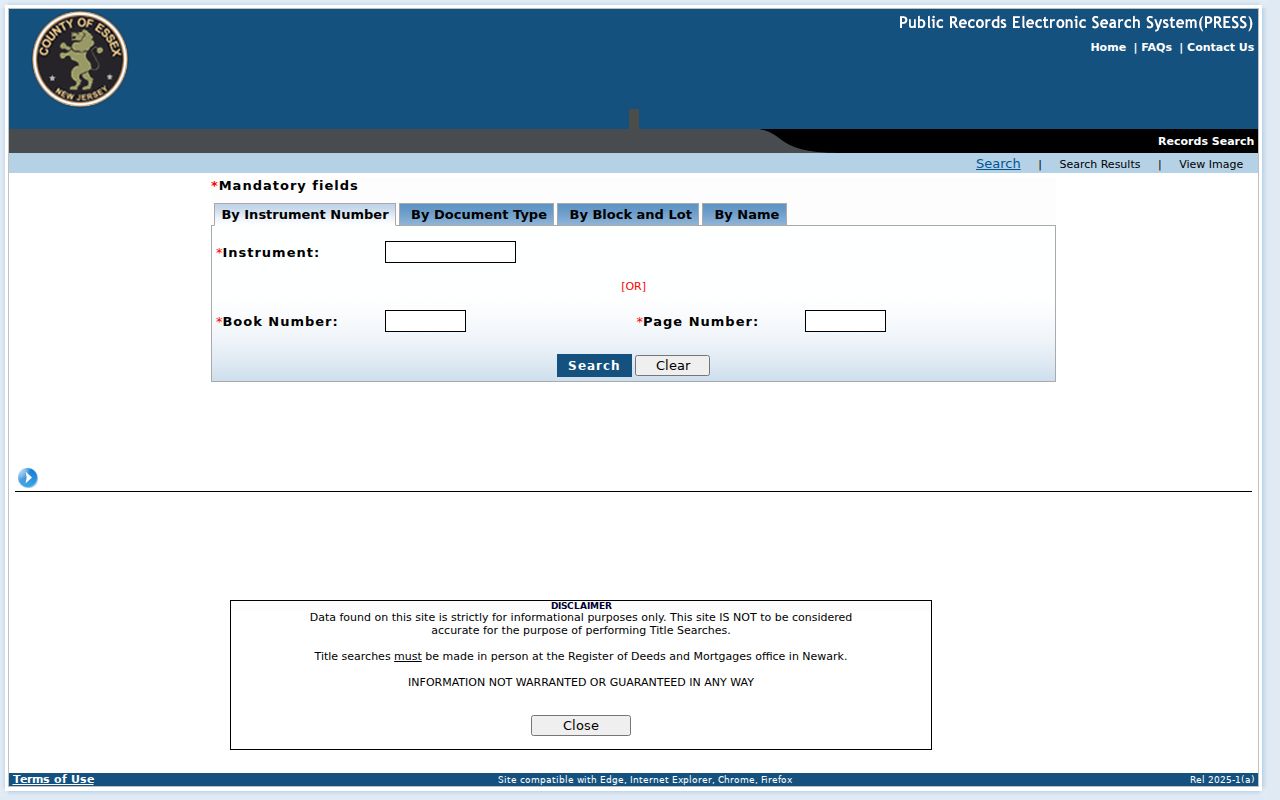
The PRESS interface supports a name route and parcel-centered routes. Its own notice says the information is not a title search. A recorded party may be a lender, trustee, estate, business, grantor, or grantee, so the instrument type and date are essential before describing the result.
| PRESS mode | Documented fields | Best use |
|---|---|---|
| Instrument | Instrument number or book and page | Retrieve a known reference. |
| Document type | Municipality, type, from/to dates | Narrow a record category. |
| Block and lot | Municipality, block, lot, date range | Follow one parcel. |
| Name | Last or company name, first name, type, dates | Check recorded parties. |
Note: Mortgage-cancellation entries before July 2, 2012 may lack a remote image even when the index entry exists, requiring an official copy or in-person retrieval.
Current East Orange Directories
Current East Orange resident sources are role-based. A parcel roll may identify an owner and assessment context. PRESS may name parties to a recorded instrument. The voter tool addresses an individual registration status. City permit files can identify an applicant or permittee when an address and time period are defined. None of these sources is a complete list of people at an address, and a search that needs one person should keep its evidence in separate, dated rows.
| East Orange source | Narrow fact | Custodian | Access route |
|---|---|---|---|
| Tax and assessor information | Property and assessment party context | East Orange Assessor | City page and linked search |
| Recorded instruments | Grantor, grantee, or other recorded party | Essex Register | PRESS or Public Vault |
| Voter status | Individual registration status | NJ Division of Elections | Individual lookup |
| Permits and violations | Address-linked applicant or record | East Orange departments | SDL or narrow OPRA request |
| Public organization contact | Published officer or meeting information | Organization or city records | Official contact page or request |
Official records are preferable because the custodian, record date, and limits are visible. Commercial people-finding tools can combine stale or mismatched material, obscure the source date, and make it hard to correct an error. Use the underlying public custodian to verify a narrow fact, especially when names are common.
East Orange Voter Records
The state’s Am I Registered? service is an individual status lookup, not an East Orange residents directory. New Jersey election materials describe a voter as inactive when election mail is returned or an address is questioned. That status can persist through election cycles unless it is updated or the person votes. It does not prove a move, a current address, or the makeup of a household.
New Jersey law treats voter information with redactions and use limits. Signatures, identification numbers, and ballot choices are not public. For an election record, the Essex Commissioner of Registration and Board of Elections are the appropriate contacts. The research did not locate a current Essex voter-file request form or fee, so confirm the lawful route directly with the election office instead of assuming an old procedure remains in effect.
East Orange Ward Geography
East Orange is a compact city with five wards, yet a historical address may be tagged with a station, plan area, or neighboring municipality instead of a ward. The official master plan describes I-280, Freeway Drive, and the Garden State Parkway as barriers that shape local continuity. It identifies crossings including Renshaw, Springdale, Park, William, Main, and Central avenues. Those landmarks can help test a historical address, but they are not a legal boundary table.
The city was organized as a township in 1863 and incorporated as a city on January 1, 1909. Census QuickFacts reports 69,612 residents in 2020 and a 2025 estimate of 72,159 for the 3.93-square-mile city. Those figures provide scale, not a named roll. An address near Orange, West Orange, South Orange, Newark, or another neighbor should be checked against the parcel municipality and legal description rather than a ZIP label alone.
Historic East Orange Directories
Historical East Orange directories are spread across combined Oranges volumes and library or State Library leads. The researched holdings include East Orange-related years 1891, 1899, 1901, and 1904; a 1918 East Orange, South Orange, and West Orange volume; combined Oranges volumes for 1926 through 1928; a 1963 Price & Lee directory; and a 1970 Price & Lee holding. A combined title is not enough by itself. Check the municipality heading and the relevant alphabetical or street section before treating an entry as East Orange.
A printed entry can associate a person, business, or household with an address at the volume’s date. Capture the volume title, year, page, name as printed, address, and section type. The full historical shelf, reverse-directory availability, and entry-reading method are handled on the East Orange city directory page.
East Orange Library Collections
East Orange Public Library is the local history starting point. Its Main Library stands at 21 South Arlington Avenue, and the Historical Society adopted a Local History Room there. The city describes books and documents about East Orange and Essex County, with older clippings and letters being preserved or scanned. Topics named in the notice include the golf course, schools, and municipal government. Confirm current hours, database access, and reproduction terms before a visit because the online finding aid was not located in the research.
The library collection provides the historical context that a deed or parcel card cannot. A clipping is still a published account, not a substitute for a primary record. When requesting help, provide a precise street, year, directory title, and whether an alphabetical or reverse section is needed.
East Orange Archive Trails
When a deed chain reaches beyond PRESS’s convenient online period, the New Jersey State Archives supplies the documented historical route. Its holdings include Essex county deed microfilm through 1900, mortgage microfilm to 1850, surrogate material through 1900, and historical vital series. The Archives also identifies birth records through 1925 and marriage and death records through 1950, subject to the relevant series and access conditions.
For house history, begin with a known parcel, follow the recorded chain backward, and check wills if a transfer gap appears. The Library of Congress East Orange Sanborn item is a 1911 map republished in 1958 with 80 sheets. It can show a structure’s footprint, use, and street context, but it does not name residents. Pair it with a dated directory entry or recorded instrument.
East Orange Evidence Limits
Different East Orange records establish different facts. Keeping the record’s narrow meaning intact makes a research result more useful and avoids turning a fragment into a personal profile. A result should state both what the source supports and what is still unknown.
- Parcel
- A mapped unit of land, often identified by block and lot.
- Index
- A searchable finding tool that may exist without an image or certified copy.
- Grantor and grantee
- The parties named in a recorded transfer, not automatic proof of occupancy.
- Criss-cross directory
- A reverse street or address section when a historical volume actually includes one.
A tax card may show an owner or mailing address. A deed identifies a transaction party and legal property link. A city directory provides a publication-year association. A court result identifies a case role. Each needs its own date, source URL, and uncertainty note.
Note: Search dates matter because a county index, an annual tax file, and a library volume can all describe different points in time.
East Orange Privacy Boundaries
New Jersey’s Open Public Records Act, N.J.S.A. 47:1A-1 et seq., provides access to government records subject to exemptions and redactions. A non-immediate request generally receives a response within seven business days. A precise request for a defined address, department, record type, and date range is more likely to reach the right custodian than a request for a list of people.
Protected information remains protected. New Jersey’s Address Confidentiality Program uses substitute addresses for eligible participants, and Daniel’s Law provides covered-person address suppression. Do not try to reconstruct a redacted or substitute address from other records. Social Security numbers, signatures, driver information, sealed matters, and confidential vital information do not belong in a residents directory.