
East Orange City Directory Holdings
Known East Orange directory leads are spread across regional volumes rather than one confirmed, uninterrupted city run. State Library and local-library sources identify East Orange-related editions for 1891, 1899, 1901, and 1904. A 1918 volume joins East Orange with South and West Orange. Combined Oranges-area volumes appear for 1926 through 1928. Later leads include a 1963 Price & Lee Oranges directory and a 1970 Price & Lee volume. Check the municipality heading, title page, and section type before treating an entry as East Orange.
| Collection | Years located | Where held | Access |
|---|---|---|---|
| East Orange-related directory leads | 1891, 1899, 1901, 1904 | State Library and local-library holdings | Confirm shelf, scan, and page access |
| East Orange, South Orange, and West Orange volume | 1918 | State Library or local archive | Alphabetical and street sections were not fully inspected |
| Combined Oranges-area volumes | 1926, 1927, 1928 | State Library or local archive | Check the city heading and street section |
| Price & Lee Oranges directories | 1963 and 1970 | Digitized/local holdings and public-library holdings | 1963 context scan; 1970 shelf lead NJ917.49/Ora/1970 |
The located years are evidence of holdings, not a statement that every year between them was printed or survives. The earliest lead is 1891, and 1970 is the latest concrete local holding lead. The complete catalog, scan coverage, and the availability of reverse sections still need confirmation from the library.
East Orange Directory Research Desk
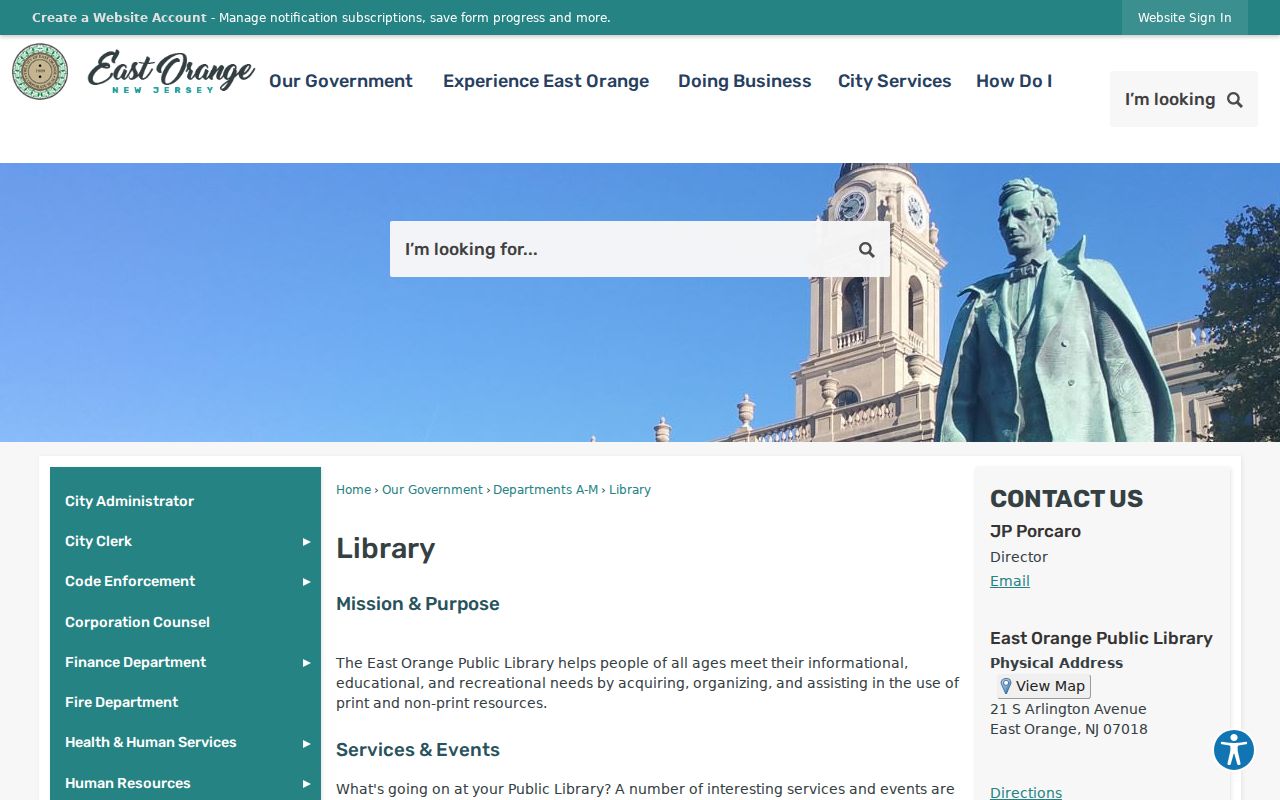
The East Orange Public Library is the key local stop for historical directory work. Its Main Library is at 21 South Arlington Avenue, and the official library page lists 973-266-5600. A 2026 city welcome packet lists the information desk at 973-266-7049, Monday through Friday hours of 9:30 a.m. to 6 p.m., and Saturday hours of 9 a.m. to 5 p.m. Hours can change, so verify before making a trip. Ask for the Local History Room, the precise volume year, the alphabetical or street section, and a page range if one is known.
The city reported that the Historical Society of East Orange adopted the Local History Room at the Main Library. Books and documents concern East Orange and Essex County, while older clippings and letters were being placed on archival paper or scanned. The cited subjects include the golf course, schools, and municipal government. The current searchable-database URL and a current finding aid were not located, so a library inquiry is more reliable than assuming an online collection is open.
East Orange Public Library's official page is the source for the Main Library access point.
The library route matters when a digital directory scan supplies only a cover or context page instead of the person or street entry needed for a citation.
East Orange Directory Years
Regional titles require a careful read. The identified volumes can combine East Orange with Orange, South Orange, West Orange, Maplewood, Hilton, or the wider Oranges area. A name or street found in one of those books does not settle the municipality by itself. Match the printed city heading with the address, then compare the result to the legal municipality or parcel record when the location is near a border.
The 1963 Price & Lee item is titled Price & Lee Co's East Orange NJ within an Oranges directory. Its inspected scan establishes the volume's historical and civic context, but not an individual entry. The 1970 Price & Lee listing is a useful shelf lead, not confirmed evidence that its pages are online. For a neighboring-city question, preserve the exact title rather than shortening it to an East Orange-only label.
Read East Orange Directory Entries
An actual East Orange personal entry from the 1963 scan was not inspected. The following fields are an extraction inventory, not a claim about what appears on every page or in every edition. Record only fields that the individual volume visibly prints. Capture the volume title, year, page, and whether the item comes from an alphabetical section or a street or reverse section.
| Name as printed | Keep spelling, initials, and the exact form used by the publisher. |
|---|---|
| Relationship notation | Preserve spouse, widow, or other notation only if the page displays it. |
| Occupation or business line | Transcribe it if printed, without assuming it proves a present affiliation. |
| Address and unit notation | Keep street number, street name, room, apartment, rear-building, or similar detail as shown. |
| Telephone and section type | Record an exchange or number if shown, plus alphabetical, street, or reverse classification. |
A city directory address is a publication-date association. It can be a business, boarding, office, mailing, or home address, and a move may have happened before or after the directory's publication date. Treat consecutive appearances as stronger historical evidence than one hit, while keeping the limits of the record clear.
Directory Marks and Sections
Small labels can change how a directory result should be read. The abbreviation key belongs with the entry citation because its meaning can vary by publisher and volume. Later books sometimes include a street-order section, but the exact reverse-section coverage of the known East Orange volumes has not been verified. Do not assume a missing name in one section means that the person never appeared elsewhere in the volume.
- Criss-cross directory
- A street-order or reverse section that may list addresses before names when the volume includes one.
- Householder index
- An alphabetical arrangement focused on the person or household identified by the publisher; its scope must be checked in that volume.
- Abbreviation key
- The publisher's explanation of shortened terms and marks, usually found in a front matter or reference section.
- Publication-date association
- A connection between a printed name and address for the directory's date, not a current-address finding.
Photograph or transcribe the key and the page heading with the entry. A short mark can distinguish a name index from a street listing, and a combined regional volume can place similar street names under different municipal headings.
East Orange Directory Timeline
The known directory sequence has large gaps. That is useful in itself because it tells a researcher when a negative result may reflect missing coverage rather than a missing household. East Orange was organized as a township in 1863 and incorporated as a city on January 1, 1909. Those civic dates help frame the older regional titles, but they do not establish publication dates beyond the library leads.
- 1863: East Orange was organized as a township.
- 1891: Earliest located East Orange-related printed-directory lead.
- 1909: East Orange was incorporated as a city on January 1.
- 1918 and 1926-1928: Located regional and combined Oranges directory leads.
- 1963 and 1970: Price & Lee holdings or scan leads; 1970 is the latest concrete local lead found.
Do not turn this into a complete publishing timeline. The research did not verify the first and last printed East Orange directory years, publication gaps, publisher changes for every volume, or the historical availability of a street section.
Trace East Orange City Directories
Follow a household through the known directory years, not through an assumed annual run. Start with the clearest name and address, then search the nearest identified volume on either side. A move, a changed spelling, or a different address role can explain why a result appears to disappear. Pair each hit with the corresponding census era or another dated record, and keep the source types separate. A directory can support historical family research without becoming a current-residence claim.
- Record the volume title, year, page, name spelling, address, and section for the first useful hit.
- Check the closest located East Orange or combined-Oranges volume before and after that year.
- Compare the printed address with any street or reverse section only when that section is actually present.
- Pair the publication year with the relevant census era, then note what the directory confirms that the census does not.
- Use library clippings, newspapers, or State Archives series as separate leads, with their own dates and citations.
For a modern, one-person verification question, the dated directory finding should be compared with an appropriate official record rather than treated as a current answer. A resident lookup can then focus on the record type that matches the present question.
East Orange Archive Routes
The New Jersey State Archives is the state-level route when a directory points to an older family or property trail. Its genealogy material identifies Essex County deed microfilm through 1900, mortgage microfilm to 1850, surrogate records on microfilm through 1900, original wills and inventories from 1670 through 1900, and Essex naturalizations by series. The Archives also offers mail reference for Essex original books and returns. These sources can clarify a historical record trail, but they do not replace a directory citation.
The naturalization coverage endpoint appears differently on official pages, as 1792-1931 on one form and 1792-1934 on the general page. Verify the specific series before stating an end year. For a historic address, Sanborn maps can identify a structure's footprint and use, while city directories can provide a name-address association for a publication year. Neither source alone identifies every person connected with a building.
East Orange Directory Context
Historic East Orange searches benefit from local place names. City history records three train lines, three trolley lines, and six stations, while current city history highlights Brick Church and East Orange stations. A directory or clipping may use a station, ward, school, church, or organization name instead of a present-day neighborhood label. Keep that wording as a search term rather than silently converting it into a modern boundary.
The local-history collection's reported subject categories, including schools, municipal government, and the golf course, can also help when a surname search fails. A historical newspaper notice may offer context, but it should be cited as a published mention and checked against a directory, archival record, or other dated source when the question turns on an address or identity.
East Orange Directory Limits
Use the directory for the narrow fact it supports: a name appears in a printed volume at a cited page and date. Misspellings, incomplete coverage, title changes, and combined-municipality volumes can create false negatives. The research did not locate a verified East Orange obituary-index title, a full local newspaper-microfilm inventory, or the library's current clipping database address. Ask the Local History Room for a finding aid, date range, reproduction rule, and page-level citation.
If a city record is needed instead, request a defined record series, date range, and department from the East Orange City Clerk. The clerk maintains municipal archives and is the municipal records custodian, but it is not automatically the keeper of county deeds, state vital records, or court files. Narrow requests produce clearer answers and preserve the record's actual role.