
East Orange Previous Residents by Era
A backward address trail uses sources that cover different periods and purposes. PRESS is the current online entry for recorded instruments. Earlier books and microfilm require the Register’s Public Vault or State Archives routes. City directories and maps can add a household or building clue for a dated period, but they do not prove that a person stayed at an address outside the date printed by the source.
| Source | Period identified | Where held | What it can establish |
|---|---|---|---|
| Essex PRESS index | Search page says from October 1, 1996 | Essex Register online | Recorded party, instrument, recording date, municipality, and image state |
| PRESS electronic transactions | Register states from May 1, 2001 | Remote access or Public Vault | Electronic transaction access, distinct from the index start date |
| Older Register books | Early 1700s reach stated for Public Vault material | Hall of Records | Earlier recorded-book route; confirm the particular book or image |
| East Orange and Oranges directories | Known leads from 1891 through 1970 | State Library and local holdings | Publication-year name and address association where a relevant section exists |
| State Archives deeds and related series | County deed microfilm through 1900; series vary | New Jersey State Archives | Earlier deed, will, surrogate, mortgage, and related historical leads |
| East Orange Sanborn map | 1911 map republished 1958, 80 sheets | Library of Congress catalog | Structure, footprint, use, and street context, not named people |
Start with the era that is known. A recent recorded transfer belongs in PRESS. A nineteenth-century deed gap belongs with State Archives microfilm and wills. A question about past residents needs a directory or other dated household source after the property trail is established.
East Orange Previous Residents in PRESS
PRESS is the official system of the Essex County Register of Deeds and Mortgages. It can search by instrument number, document type, block and lot, or name. For a backward history, block and lot can keep the research tied to a parcel even when the recorded document uses an older address form. Name searching then helps connect the current seller to an earlier purchase, but spelling variants, initials, trusts, estates, lenders, and organizations require the party role to be read carefully.
The coverage dates need precise wording. The search page says its index begins October 1, 1996. The Register describes remote electronic transactions from May 1, 2001. The Public Vault reaches older books into the early 1700s. Neither date tells the whole story about image availability. Mortgage-cancellation entries before July 2, 2012 can be indexed without electronic images, requiring an official copy at the office.
The Essex PRESS search is the direct recorded-instrument route for an East Orange address.
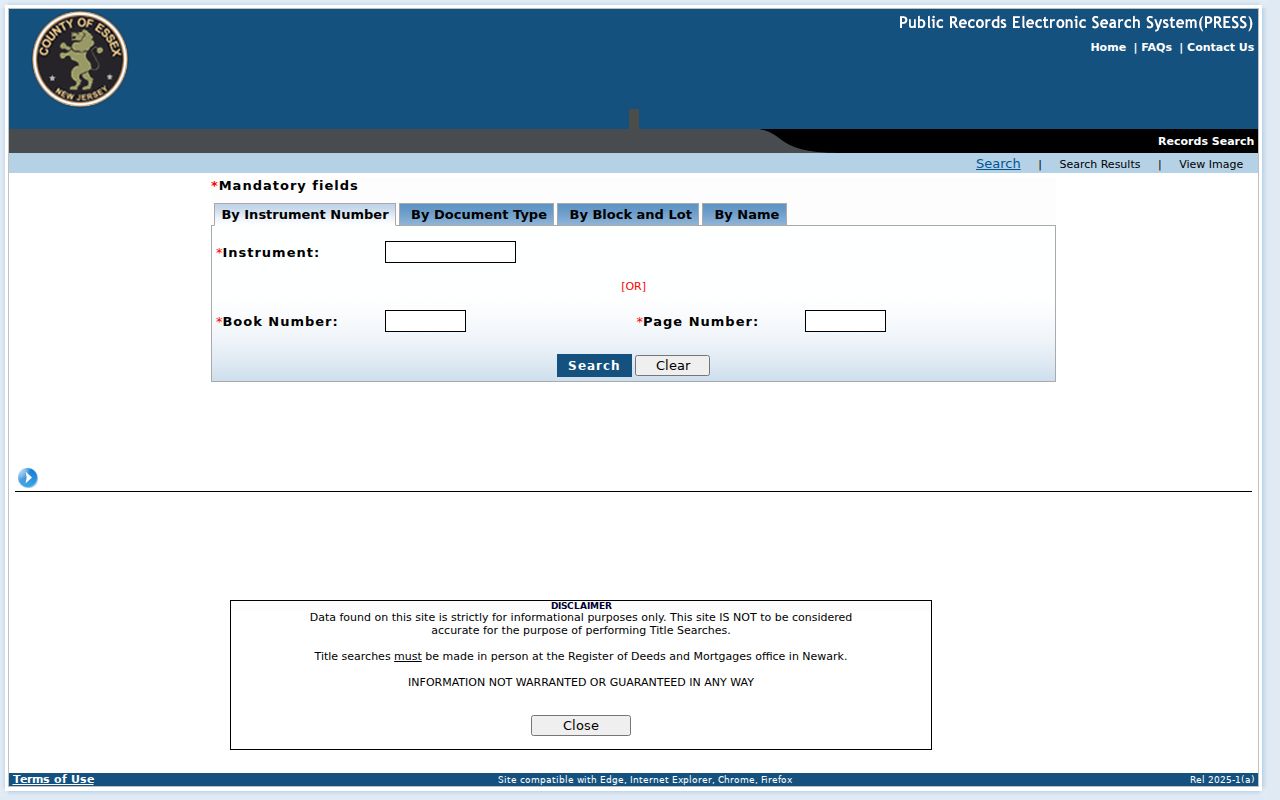
Use the official portal to preserve the selected search mode, date range, result count, and whether a document is an index-only result or an available image.
East Orange House History Sources
New Jersey’s Historic Preservation Office recommends starting from the current deed and working backward through grantor and grantee references. When a transfer gap appears, search wills under the last known owner. The New Jersey State Archives provides the deeper route for Essex county deed microfilm through 1900, mortgage microfilm to 1850, Essex surrogate records on microfilm through 1900, original wills and inventories, and other historical series. Series dates and access terms still need to be checked for the specific record.
The New Jersey house-history guide supports the chain-of-title method used for East Orange previous residents research.
A deed chain records property relationships. It must be paired with a dated directory or other source before describing a past household at the address.
East Orange Previous Residents and Maps
Maps help solve a different part of the question. The Library of Congress catalog identifies an East Orange 1911 Sanborn map, republished in 1958, with 80 sheets. A sheet can show the footprint, outbuildings, street setting, or use of a structure at the map’s date. It cannot identify prior residents. Pair it with a directory page, recorded instrument, or dated clipping rather than treating a map as a household record.
The East Orange Public Library Main Library Local History Room is a practical companion for address history. The Historical Society adopted the room, which includes books, documents, letters, clippings, and materials about East Orange and Essex County. The city described work to preserve or scan older clippings and letters, but a current database URL and finding aid were not located. Ask for the item, date range, street, and desired section instead of assuming an online name search exists.
East Orange Addresses Across Years
East Orange Plans and Construction maintains the street-numbering system and tax maps, but an official historical renumbering or street-renaming index was not located. Keep an old address exactly as printed in the source and record a possible current equivalent in a separate field. A unit number, rear designation, street suffix, ward or plan-area label, postal ZIP, tax municipality, and block and lot can each matter when a historical address does not match a modern form.
East Orange was organized as a township in 1863 and incorporated as a city on January 1, 1909. That local history is a useful date marker for a record’s municipal wording, but it does not resolve an address by itself. The city’s neighbors also appear in combined Oranges directories. For a border or ambiguous address, compare the directory’s municipality heading with parcel municipality and the deed’s legal description.
Note: A postal ZIP is only a delivery field and should not replace the legal municipality or parcel identifier.
Trace East Orange Deed Records Backward
The property trail begins with the known address or parcel, not an assumed occupant. Pull the current property context from the assessor or tax route, then work from the latest recorded conveyance backward. The chain can reveal a sequence of recorded owners, trustees, estates, lenders, or organizations. It does not establish that every recorded party lived at the property.
- Record the full situs address, municipality, block, lot, qualifier, and any separate owner or mailing field shown by the assessor or tax source.
- Find the relevant deed in PRESS by instrument, block and lot, document type, or party name. Save the instrument number, recording date, document type, and image state.
- Read the recorded grantee and grantor roles. Search the prior recorded owner as a grantee to locate an earlier acquisition, then repeat the documented trail.
- Keep the legal description and referenced book, page, or instrument with every step. It is often more stable than an address when older records use different street forms.
- When the remote trail reaches its limit, use the Register’s Public Vault or contact the State Archives for the appropriate historical book, microfilm, or will route.
- Grantor
- The party who conveys or transfers an interest in a recorded instrument.
- Grantee
- The party receiving that interest. A grantee’s role is not, by itself, proof of residence.
- Chain of title
- The documented succession of property interests traced through instruments and related records.
- Legal description
- The land description used in a recorded document. It can identify the parcel when street addressing changes.
Past East Orange Households in Directories
Directories provide the household layer for previous residents research. The known East Orange-related leads include volumes for 1891, 1899, 1901, 1904, 1918, 1926 through 1928, 1963, and 1970. Because many titles combine East Orange with Orange, South Orange, West Orange, Maplewood, Hilton, or the larger Oranges region, verify both the municipality heading and the relevant street or alphabetical section before using an entry.
For each useful entry, retain the volume title, year, page, name as printed, address, any telephone or business line that is actually printed, and the section type. A directory address may be a business, mailing, boarding, office, or home address. It is a publication-date association and should not be presented as a current roster.
The historical collections themselves are described on the East Orange city directory. The Main Library can confirm whether a particular volume contains a reverse section, which is the key feature for starting with a house number rather than a name.
East Orange Previous Residents and Census
Pair a directory year with the closest available census year only after the address and municipality have been checked. Compare the printed address, spelling, household composition, and source dates. A mismatch may reflect a move, a different publication date, a business address, an address-number change, or an error in one source. It is not a reason to merge two same-name entries without other identifiers.
The research did not establish an East Orange address-index route or a verified local census collection. Treat any census search as a separate historical source and cite its collection, year, page or image reference, and enumeration details. State only the narrow fact supported by the record. If household identity remains uncertain, leave it unresolved.
Limits on East Orange Previous Residents
Previous residents research is strongest when it distinguishes a property fact from a household fact. A deed can name a grantee. An assessment can name an owner. A directory can print a person and address in one year. A map can show a building. None of those sources alone proves a person’s full history at an address or identifies every past household member.
Respect redactions and protected addresses. New Jersey’s Address Confidentiality Program supplies substitute addresses for eligible people, while Daniel’s Law supports suppression for covered persons. A substitute or redacted address must not be reverse engineered through other records. New Jersey’s anti-stalking and harassment laws apply even when individual record fragments are public.